
Eric on the First Hampton reading of ‘What to the slave is the fourth of July”
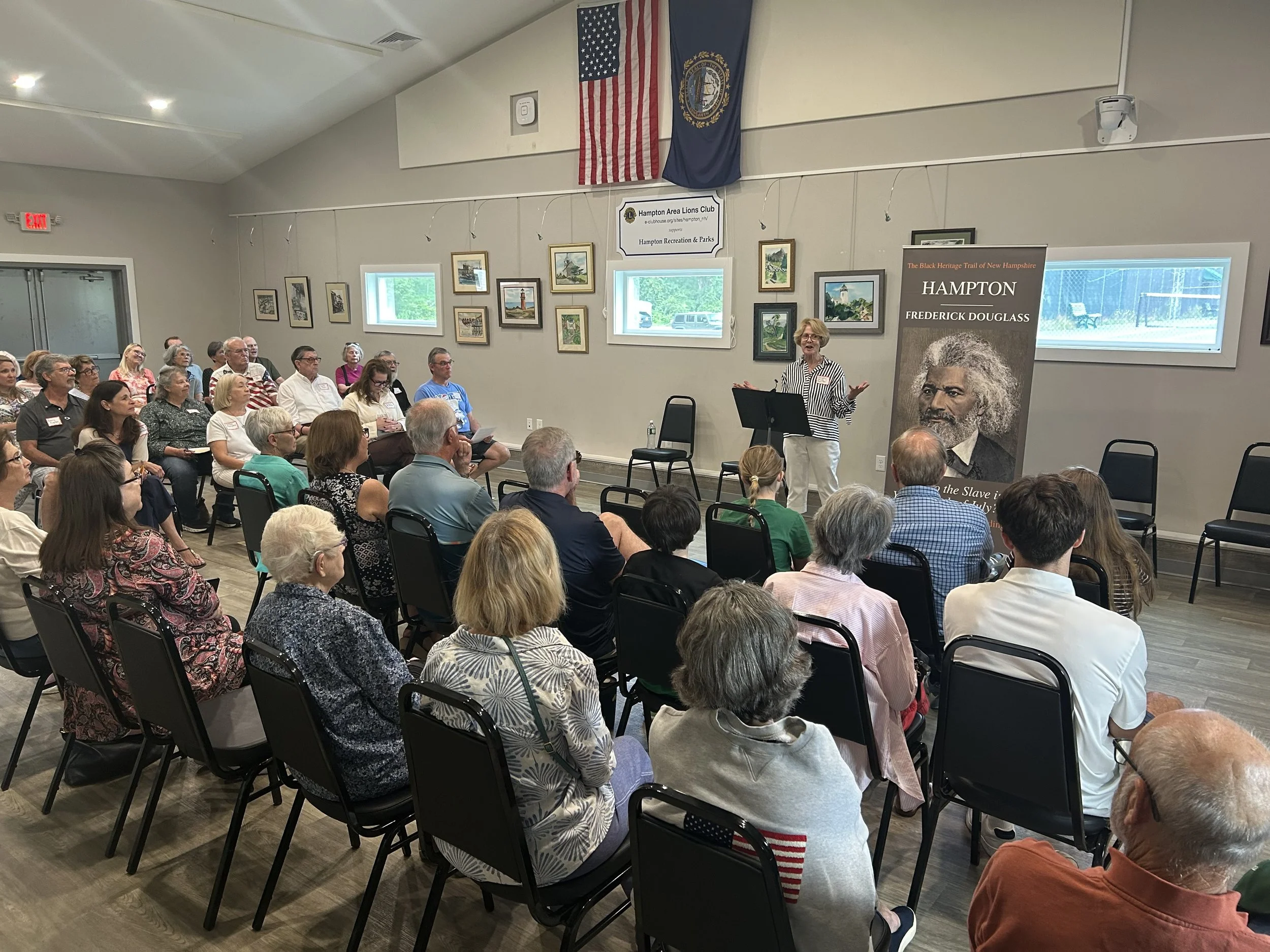
A large audience assembled to hear “What to the Slave is the Fourth of July” read for the first time in Hampton!
This year, for the first time, Hampton held its own public reading of Frederick Douglass's 1852 speech, "What to the Slave Is the Fourth of July?" I was lucky enough to be part of it. The Hampton Democrats partnered with the Black Heritage Trail of New Hampshire to bring this event to town as a non-partisan community gathering. It was a first for Hampton, and it was extremely moving.
First, a huge congratulations to Christy Slavik Hamilton for spending the last two years planning for this event. It wasnʼt easy to get to this moment, but she was committed and relentless in her approach.
There was something significant about Hampton doing this for the first time this year, with the United States' 250th right around the corner. As a country, we're about to spend a lot of time celebrating our founding, and I think that makes it more important, to sit with the parts of our history that don't fit neatly into the celebration.
When I got home and reflected on the day, one passage stayed in my mind:
"For it is not light that is needed, but fire; it is not the gentle shower, but thunder. We need the storm, the whirlwind, and the earthquake. The feeling of the nation must be quickened; the conscience of the nation must be roused; the propriety of the nation must be startled; the hypocrisy of the nation must be exposed; and its crimes against God and man must be proclaimed and denounced."
I found the Douglassʼs ability to confront injustice with courage and resolve inspiring. I think it spoke to his moral clarity and the moral clarity that this moment in our country's history demands.
Douglass wrote this speech to be spoken, and you can feel that in the rhythm of it. It builds, it engages you and it makes you reflect. Reading it aloud alongside neighbors, each taking a turn with a different section, took my breath away. Hearing my neighbors and friends speak his powerful and prophetic words made me feel strong and connected to my community and our shared history.
What struck me most was how much power and applicability Douglass's words still hold today. He points out the irony of a nation that broke from England for being "unjust, unreasonable, and oppressive, and all together such as ought not to be quietly submitted to," and then asks how that same nation could turn around and be at peace with slavery.
I look at our nation today and ask a similar question. How can we be a country where my kids pledge "liberty and justice for all" every morning in school, while we still don't see that equality lived out for Black Americans? Where people are passed over for jobs, denied housing, and face bias just for who they are. That's the distance Douglass was describing in 1852, and it's why this speech is still being read aloud on porches and in town halls today instead of sitting quietly on a shelf. It hasn't finished being true yet.
That distance between what we say and how we actually treat people is exactly what leadership is supposed to close. It's easy to praise the right values in theory. As Douglass put it, 'To say now that America was right, and England was wrong is exceedingly easy.' What we need is leadership that takes action to close the gap between the stories we tell ourselves and reality in which we live.
This was Hamptons first reading, and I hope it's the first of many, not just as an annual reading, but as a reminder of the moral seriousness we should be asking of the people who lead us, and of ourselves.
